

What a Fully Designed NYC Home Looks Like When Every Detail Is Managed by a Full-Service Interior Designer
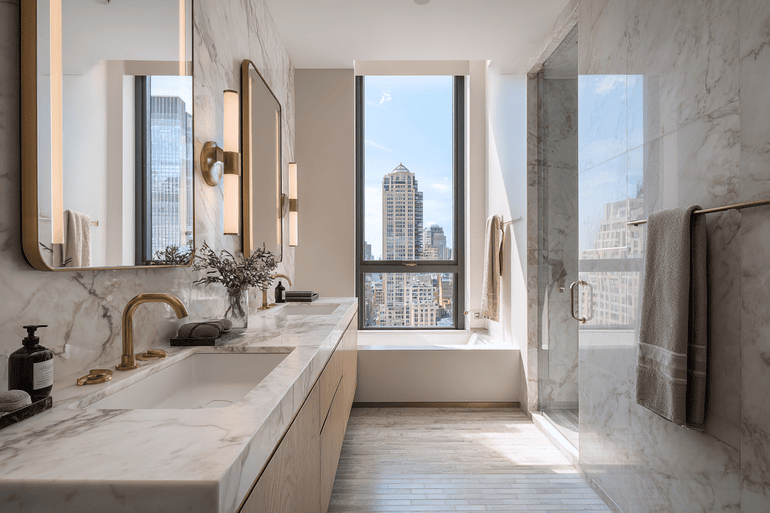
A fully designed home, managed by a full-service interior designer, is a residence where every visual, spatial, and functional decision has been planned, coordinated, and executed under one expert's oversight from the first sketch to the final styling.
What that covers, at a glance:
- Floor plans, space planning, and architectural changes
- Material and finish selection (stone, wood, fabric, hardware)
- Custom furniture design and procurement
- Contractor coordination and construction oversight
- Lighting design, built-ins, and millwork
- Art, accessories, and final styling
In New York City, that list gets longer. Pre-war buildings have structural quirks. Co-op boards have approval requirements. Freight elevators have size restrictions. Building management has rules about working hours. A full-service interior designer in NYC doesn't just design they navigate all of it on your behalf.
Why "Full-Service" Means Something Different in New York City
Full-service interior design in NYC means managing an unusually complex web of people, approvals, and constraints that simply don't exist in most other markets.
A renovation in a Manhattan high-rise or a Brooklyn brownstone involves architects, structural engineers, licensed contractors, co-op or condo boards, building superintendents, and sometimes Landmarks Preservation Commission approvals. The designer sits at the center of that web. They communicate with every party, manage every deadline, and make sure the decisions made on paper actually translate into what gets built.
Here's where this matters: most homeowners underestimate how many moving parts are involved. What looks like a kitchen renovation is actually a sequencing exercise involving demolition, plumbing, electrical, custom cabinetry lead times, appliance delivery windows, and building-specific rules about noise and debris removal. A full-service interior designer handles all of that. The client doesn't receive contractor calls, doesn't manage delivery schedules, and doesn't troubleshoot problems that come up mid-project.
That's the actual value of full-service: the complexity runs behind the scenes.
-1779458103348.webp)
What the Home Actually Looks Like: Room by Room
A fully designed NYC home looks intentional in a way that's hard to fake. Every room has a clear point of view, and the decisions in one room connect to the decisions in the next.
The Entry
The entry of a well-designed NYC apartment sets the register for everything that follows. In high-end residential work, this space gets as much attention as any other often more, because first impressions are irreversible.
What this typically involves:
- Custom millwork or built-in storage that solves NYC's chronic lack of closet space
- Carefully considered lighting (often a combination of overhead and accent sources)
- A material moment, stone flooring, a textured wall treatment, a console in a distinctive material
- Artwork placed with intention, not habit
A high-end interior designer in NYC approaches the entry as architecture, not decoration.
Living and Dining Areas
The living areas of a fully designed home are where the overall design concept becomes most visible. Furniture is not purchased from a single retailer and arranged by default. It is selected or custom-designed to work within the specific proportions of the room, the height of the ceilings, the quality of the natural light, and the way the client actually lives.
In NYC apartments, this often means:
- Custom sofas scaled to pre-war proportions or low-ceilinged post-war layouts
- Rugs sized and placed with architectural precision
- Window treatments that address light, privacy, and proportion simultaneously
- Built-in storage or shelving designed to disappear into the architecture
What most people don't realize is that a room can contain beautiful individual pieces and still feel unresolved. The full-service process eliminates that outcome because the designer controls every element, not just the ones the client notices.

The Kitchen
The kitchen in a high-end NYC renovation is typically one of the most technically complex rooms in the project. It involves cabinetry lead times of 12 to 20 weeks, coordination between plumbing and electrical rough-ins, appliance specifications that have to be confirmed before walls close, and material selections that need to work together across stone, metal, and wood.
A full-service interior designer manages all of that sequencing. The client makes decisions choosing the stone, approving the cabinet profile, selecting the hardware but they don't manage the vendors, the timelines, or the problems that come up when a slab has more movement than expected or an appliance ships damaged.
The result, in a well-executed project, is a kitchen that functions exactly as designed and holds up visually over time. The details, the reveal on the cabinet doors, the edge profile on the countertop, the placement of the toe kick are resolved at a level most kitchens never reach.
Primary Bedroom and Bath
The primary bedroom in a fully designed home is quiet in the best sense. The materials work together. The lighting has been thought through for morning and evening. The storage is resolved. Nothing is competing for attention.
In NYC, this often means:
- Custom closet systems designed around the client's actual wardrobe
- Bedside lighting that doesn't require getting up to turn off
- Window treatments that block light effectively without looking institutional
- A material palette that is consistent but not repetitive
The primary bath in a high-end project is where material selection becomes most rigorous. Stone selection happens in person, at the slab yard, because photographs cannot convey movement, veining, or the way a material reads at scale. A full-service interior designer makes those selections with the client, or on their behalf, and ensures that the installation reflects the intention.
Secondary Spaces and the Details Nobody Names
-1779458305360.webp)
A fully designed home is also resolved in the spaces nobody talks about: the hallways, the laundry room, the home office, the powder room. These are the rooms that reveal whether a project was truly full-service or just selectively curated.
In NYC projects, this comes up often. Clients will describe a beautifully renovated apartment and then mention, almost offhand, that the hallway never got finished or the second bathroom still has the original tile. A full-service scope covers the whole home. The details in the spaces nobody photographs matter as much as the ones they do.
The Process Behind the Result
In New York City, most high-end renovations are led by full-service interior design firms because of the level of coordination involved. The process that produces a fully designed home is long, detailed, and non-linear and it requires someone whose entire job is to manage it.
Here is what that process typically looks like:
- Discovery and programming — Understanding how the client lives, what they need, and what they want the home to feel like.
- Concept development — Establishing the design direction: materials, palette, spatial approach, reference points.
- Space planning and architecture — Working with the architect (or leading architectural decisions directly) on layout, flow, and structural changes.
- Drawings and specifications — Producing the detailed documentation that contractors, fabricators, and vendors build from.
- Procurement — Ordering furniture, custom pieces, materials, lighting, hardware, and accessories. Managing lead times and tracking deliveries.
- Construction administration — Attending site visits, reviewing work in progress, catching problems before they become expensive.
- Installation and styling — Coordinating the move-in of furniture and objects, placing art, and styling the final spaces.
For most renovation projects in NYC, a full-service interior designer is the most practical choice because no other model manages all seven of those phases under one roof.
-1779458340343.webp)
What Clients Actually Experience
The white-glove experience in full-service interior design is not about luxury for its own sake. It is about protecting the client's time and decision-making energy.
A well-run full-service project means the client is involved in the decisions that matter to them the feel of the home, the materials they will live with, the way spaces function and not involved in the decisions that don't. They are not chasing contractors for updates. They are not on the phone with a stone fabricator about a delivery window. They are not managing the twelve separate vendors whose work has to land in the right sequence.
That is what full-service interior design in NYC actually delivers. Not just a beautiful home though that is the result but a process that does not consume the client's life while it's happening.
How to Recognize a Fully Designed Home
There are qualities in a fully designed home that are immediately perceptible, even if they are hard to name.
The space feels resolved. There are no unfinished corners, no furniture that doesn't quite fit, no lighting that feels like an afterthought.
The materials hold together. Stone, wood, metal, fabric, and paint work in relation to each other. Nothing is fighting for dominance.
The scale is right. Furniture relates to the room. Lighting relates to the ceiling height. Art relates to the wall.
It feels like the people who live there. A fully designed home is not a showroom. It has personality, specificity, and a point of view that belongs to the people who commissioned it.
The details are finished. The reveals are tight, the transitions are clean, and the things nobody looks at directly the quality of the hardware, the edge of the millwork, the hem of the drapery are exactly right.
In high-end residential work, this level of resolution is the standard. It does not happen by accident and it does not happen without a full-service process to produce it.
-1779458373043.webp)
Frequently Asked Questions
What does a full-service interior designer actually do?
A full-service interior designer manages the entire design and renovation process, from concept through construction to final styling. They handle every vendor, every approval, and every decision that the client does not want to manage themselves.
How is full-service interior design different from decorating?
Decorating typically refers to furnishings, color, and accessories. Full-service interior design includes architecture, construction, space planning, custom fabrication, procurement, and project management. It is a broader and more comprehensive scope.
How long does a full-service interior design project in NYC take?
Most high-end residential projects in New York City take between 12 and 24 months, depending on the scope of renovation, the complexity of approvals, and the lead times on custom items. Some larger projects run longer.
Do I need board approval to renovate my NYC apartment?
If you live in a co-op or condo, almost certainly yes. The scope of what requires board approval varies by building, but structural changes, wet work, and anything that affects building systems typically requires an alteration agreement. A full-service interior designer in NYC will be familiar with this process and can help prepare the necessary documentation.
Why does high-end interior design in NYC cost more than other markets?
Labor rates, material costs, building logistics, and the time required to navigate approvals all drive costs higher in New York City than in most other cities. The complexity of the market is real and it is one of the reasons that having an experienced designer managing the process is worth the investment.
What should I look for when hiring a full-service interior designer in NYC?
Look for a designer whose portfolio reflects work at a similar scale and budget. Ask how their firm is structured, who manages the project day to day, how many projects they run simultaneously, and how they handle communication during construction. The quality of the relationship matters as much as the quality of the work.
Can a full-service designer work within a specific budget?
Yes. A good full-service interior designer will establish a realistic budget framework early in the process and make design decisions that reflect it. Budget and quality are not the same thing, a well-run project at a moderate budget will outperform a poorly managed project at a higher one.
What is the difference between an interior designer and an interior decorator in New York?
In New York State, the title "interior designer" is a certified designation that requires education, examination, and experience. Interior decorators do not have the same credentialing requirements. For a full renovation especially one involving structural changes or building systems, working with a certified interior designer is important.
At what point in a project should I bring in a full-service interior designer?
As early as possible, ideally before you have made any commitments about layout, contractors, or materials. The earlier a designer is involved, the more influence they have over decisions that are difficult and expensive to change later.
What does the final installation phase look like?
The installation phase is when the project becomes visible as a home. Furniture arrives, art is placed, accessories are styled, and the designer makes the final adjustments that bring the space to life. For the client, it is usually the first time the full picture comes together. For the designer, it is the payoff of a process that has been running for months.