

Design Intelligence 2025: Materials, Color, and Wellness That Endure
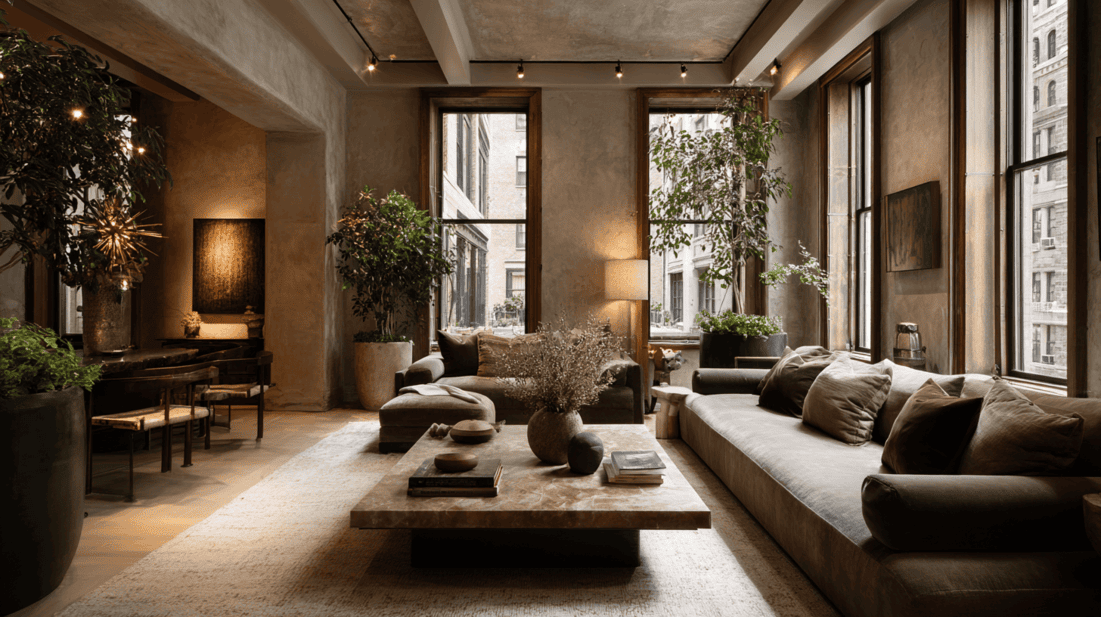
What should top-tier clients actually invest in this year? Here’s our research-backed framework for 2025: how to use color with confidence, specify healthier and lower-carbon materials, embed biophilic wellness that’s more than a potted plant, and design for circularity—especially relevant in NYC.
Who this is for: design-savvy homeowners, architects, and developers who want a timeless result (not a fad).
You’ll get: a clear decision framework, and spec-ready guidance.
TL;DR (The 5 Moves That Matter)
- Color: Warmer, grounded neutrals (think nuanced browns) paired with heritage, desaturated hues; treat color as a material, not paint on top (Pantone 2025, Farrow & Ball New Colours).
- Materials: Favor products with EPDs and documented low emissions; verify formaldehyde limits for composites; use limewash, real wood, stone, and clay plasters thoughtfully (EPD overview, TSCA Title VI).
- Wellness: Biophilic strategies (daylight, views, nature analogues) measurably improve comfort and cognition when done intentionally (Biophilic design).
- Structure & Aesthetics: Mass timber & natural finishes are desirable—but design for acoustics, fire, and moisture up front (Mass timber acoustics, Mass Timber Design Manual).
- Circularity & NYC Lens: Design to reuse and adapt; LL97 pressures large buildings to reduce emissions—your interior choices (electrification-ready kitchens, envelope upgrades, efficient lighting) can help (LL97, NYC Circular Guidelines).
How We Built This (Method)
We synthesized 2025 guidance and standards updates (LEED v5), peer-reviewed and industry research (biophilic design, mass timber), and manufacturer transparency frameworks (EPDs), then translated them into practical interior specifications for NYC projects (LEED v5 overview, Biophilic design, Mass Timber Design Manual, EPD overview).
1) Color Intelligence 2025: Grounded Neutrals + Quiet Heritage
What we’re seeing: a shift from stark whites to nuanced, tactile neutrals—especially complex browns—balanced with desaturated heritage tones (deep olives, dusty reds, stony taupes). Pantone’s Mocha Mousse captures the broader swing toward warm, cocooning palettes; Farrow & Ball’s 2025 additions and revived archive shades echo this move with earthy, quietly luxurious depth (Pantone 2025, Farrow & Ball New Colours).
How to deploy (principles):
- Treat color as materiality—glaze, limewash, or plaster for depth and light scatter.
- Use tonal layering (walls, millwork, textiles) with one accent family rather than many accents.
- Keep sheen levels low for sophistication and glare control.
Spec Box: matte/mineral finishes (limewash or clay plaster), low-sheen lacquers on cabinetry, woven naturals (wool, linen), bronzed or patinated metals.

2) Materials That Age Beautifully (and Document Performance)
Why it matters: Clients increasingly ask for lower-carbon and healthier interiors. Two practical levers:
- Environmental Product Declarations (EPDs): life-cycle, third-party verified disclosures for comparable product impacts. Specify products with available Type III EPDs when possible (EPD overview).
- Indoor Air & Emissions: For composite woods and adhesives, confirm compliance with U.S. formaldehyde standards (TSCA Title VI) and select low-VOC finishes to reduce indoor pollutants (TSCA Title VI).
Designer checklist:
- Ask vendors for EPD + emissions documentation in submittals.
- Prefer solid wood, natural stone, ceramic, linoleum, wool; use engineered products with verified emissions data.
- Finish systems: water-borne or plant-based where possible; confirm cure times before occupancy.
NYC tip: Track LEED v5 credits relevant to interiors; they emphasize carbon, resilience, and quality of life—useful even if you’re not certifying (LEED v5 overview, LEED v5 ID+C Guide).

3) Biophilic Design That’s More Than a Fiddle-Leaf Fig
The evidence: Biophilic principles—daylight, views, natural forms and materials—are linked to reduced stress and improved comfort; recent research also highlights positive impacts on cognition and productivity when nature is intentionally integrated (Biophilic design, Biophilic patterns PDF).
Implement the “3-3-3” rule:
- 3 Sources of Nature: daylight strategy, real planting, and tactile natural materials.
- 3 Spatial Moves: refuge (nook or alcove), prospect (long view), and mild mystery (partial screening that invites exploration).
- 3 Maintenance Plans: irrigation or plant care schedule, daylight glare control, and seasonal refresh.

4) Mass Timber & Natural Finishes: Warmth with a Technical Backbone
Left exposed, mass timber and natural finishes deliver warmth and acoustic richness—but require informed detailing. State-of-the-art reviews emphasize integrated strategies for moisture, fire, and acoustics in building physics design. If you want the timber look without noise issues, pair wood ceilings/walls with concealed absorptive layers and soft furnishings. (Mass timber acoustics, Mass Timber Design Manual).
Sound note: Exposed timber reduces conventional ceiling finishes that usually help dampen sound; plan early for acoustic absorption and flanking paths (Mass timber acoustics).

5) Circularity: Design for Reuse, Disassembly, and Long Service Life
The idea: Design choices should eliminate waste, keep materials in circulation at high value, and support regeneration—translate that into interiors by designing for disassembly, choosing durable modular systems, and specifying refurbishable furniture (NYC Circular Guidelines).
NYC angle: The city’s circular construction guidance encourages renewable/low-embodied-carbon materials and prioritized local reuse pathways—good practice for residential and hospitality fit-outs (NYCEDC Circular Guidelines PDF).
Quick wins:
- Modular millwork with replaceable fronts.
- Area rugs with take-back programs.
- Hardware and lighting from brands offering re-finishing or re-manufacture.

6) The NYC Lens: Interiors that Support LL97 Goals
While Local Law 97 targets large-building emissions, interior decisions (electrification-ready kitchens, efficient lighting controls, better window assemblies, and air sealing adjacent to interior scopes) help owners meet limits now through 2030—prioritize induction, heat-pump-ready layouts, and envelope improvements coordinated with renovations (LL97).

7) Putting It Together: Two Palettes That Will Age Well
Palette A — Quiet Heritage
- Walls: mineral limewash in warm taupe
- Millwork: deep olive satin
- Stone: honed travertine
- Metals: burnished brass
- Textiles: undyed wool & linen
- Accent: dusty red (select panels or art)

Palette B — Modern Nature
- Walls: clay plaster in sand
- Millwork: rift white oak, low sheen
- Stone: domestically sourced limestone
- Metals: matte nickel
- Textiles: bouclé and recycled cotton
- Accent: mocha-brown leather

8) Spec-Ready Checklist (Copy/Paste into Your Brief)
- Color Strategy: target ΔE<2 across painted panels; specify low-sheen; include a sample wall review under natural + artificial light.
- Documentation: request Type III EPDs; emissions declarations (TSCA Title VI for composites); VOC content & emission certificates (EPD overview, TSCA Title VI).
- Wellness: daylight & glare plan; biophilic elements (materials, planting, refuge/prospect moments) documented on drawings (Biophilic design).
- Acoustics: absorption coefficients for textiles/ceiling systems if exposing timber; flanking path details (Mass timber acoustics).
- Circularity: submittals to include disassembly diagrams, spare parts list, and refurbishment pathways (NYC Circular Guidelines).
- NYC/LEED lens: coordinate with LL97 strategies and consider LEED v5 ID+C pathways for interiors (LL97, LEED v5 ID+C Guide).
Appendix: References & Further Reading
- LEED v5 emphasis on carbon, resilience, quality of life (2025 cadence): LEED v5 overview, LEED v5 ID+C Guide.
- EPDs—what they are and why they matter: EPD overview.
- Indoor air & formaldehyde regulations/resources: TSCA Title VI, ECFR 40 CFR Part 770, TSCA small entity guide.
- Biophilic design evidence and patterns: Biophilic design, Biophilic patterns PDF.
- Mass timber design considerations (acoustics, fire, moisture): Mass timber acoustics, CLT Handbook (Swedish Wood), Mass Timber Design Manual.
- Color 2025: Pantone’s Mocha Mousse; Farrow & Ball’s new and revived hues: Pantone 2025, Farrow & Ball New Colours.
- Circular construction in NYC guidelines: NYC Circular Guidelines, NYCEDC Circular Guidelines PDF.
- NYC Local Law 97 overview and compliance timeline: LL97.